лого Certification Center

Certification (ISO)

Boost trust in your brand through ISO certification of products and manufacturing — start today!

Submit a request

ISO Certification

ISO Certification

ISO Certification is proof of your enterprise management systems' compliance with strict international standards. Implementing ISO helps optimize internal processes, reduce defect rates, and guarantee consistently high product quality.

What certification gives your business:
  • Export Access: opens doors to major foreign markets and tenders.
  • Partner Trust: increases investment attractiveness and company status.
  • Competitive Advantage: sets your brand apart from other market players.

ISO Standards are applied for:

  • Ensuring stable product and service quality matching global criteria.
  • Enhancing industrial safety levels and protecting personnel health at facilities.
  • Unifying and digitalizing manufacturing and management processes.
  • Eliminating technical barriers for free entry into international markets.
  • Protecting corporate data, IT infrastructure, and confidential client information.
  • Reducing environmental risks and minimizing negative ecological impact.
  • Optimizing operational expenses by reducing defect volume and production losses.
  • Ensuring business continuity amidst crises and external market shifts.
  • Growing brand trust, loyalty, and authority among clients, investors, and state regulators.

Benefits of ISO Standardization for Your Business

Implementing international ISO standards is a strategic decision that elevates company management and unlocks access to large markets.

  • Global Reach. ISO certificate removes technical barriers, enabling legal product export and international partnership.
  • Winning Tenders & Procurement. ISO is often a mandatory prerequisite for competing in large commercial and state tenders.
  • Increased Trust & Reputation. The ISO seal on your website and products is a universally recognized mark of reliability boosting customer and investor loyalty.
  • Cost & Defect Reduction. Process optimization and standardization help cut expenses, minimize errors, and accelerate workflow.
  • Risk Management. Standards embed safety culture and systematic control, protecting business from unexpected crises and legal issues.

Main Types of ISO Standards

1. Quality Management System: ISO 9001 — quality management system (one of the most widely used standards) 2. Occupational Health and Safety: ISO 45001 — occupational health and safety management system 3. Environmental Management: ISO 14001 — environmental management 4. Information Security: ISO/IEC 27001 — information and data security 5. Food Safety: ISO 22000 — food safety management system 6. International Welder: ISO 9606 certification 7. Medical Standards: standards regulating quality of medical devices and services 8. Education & Training: standards in learning, qualifications, and vocational training

Key Focus Areas and ISO Standards

We help companies and professionals comply with global requirements across key market sectors:

  • Welding & Metalworking:

    ISO 9606 — international welder certification for the global market.

  • Construction, Electrical & Mechanical Engineering:

    ISO 9001 — leading global quality management system (QMS) for building, contracting, and engineering.

  • Maintenance & Safety:

    ISO 45001 — occupational health and safety management system.

  • IT & Data Protection:

    ISO/IEC 27001 — international standard for comprehensive information security.

  • Environmental Management:

    ISO 14001 — managing environmental risks and implementing green standards in production.

  • Food Industry & Safety:

    ISO 22000 — food safety management system (HACCP) at all stages.

  • Healthcare & Medicine:

    ISO 13485 / ISO 15189 — quality standards for medical devices, laboratories, and services.

  • Education & International Training:

    ISO 21001 — professional learning standards for international labor market.

Application of ISO Certificate

Implementation and confirmation of ISO standards unlocks new career opportunities for specialists and is used for:

  • International Qualification Legalization. The certificate converts local experience into a transparent, internationally recognized format without complex diploma re-evaluations.
  • Higher Labor Market Competitiveness. Independent international evaluation instantly distinguishes candidates when applying for high-demand, well-paid roles.
  • Seamless Overseas Employment. Officially eliminates cross-border hurdles, easing integration into foreign manufacturing, construction, and engineering firms.
  • Objective Skills Verification. ISO acts as the primary independent guarantee that practical competencies and work methods strictly adhere to global codes.
  • Building Unshakeable Employer Trust. Major international corporations, main contractors, and tender clients receive documented proof of employee reliability and safety.

International Certification at 'Tashkent International Certification Academy'

  • EN ISO 14732 — certification of welding operators;
  • EN ISO 13585 — certification of brazers and brazing operators;
  • EN ISO 15614 series — qualification of welding procedures (WPQR);
  • EN 13134 — certification of brazing processes;
  • EN ISO 3834 — quality requirements for fusion welding of metallic materials;
  • EN 1090 — certification of steel/aluminum structural components and product CE marking;
  • LVD (Low Voltage Directive) — directive on low voltage equipment;
  • PED 2014/68/EU — Pressure Equipment Directive;
  • CPR (Construction Products Regulation) — regulation and certification of construction products;
  • EN ISO 9001, EN ISO 14001, EN ISO 45001, EN ISO 50001 — quality, environmental, occupational health & safety, and energy management system standards;
  • Certification of organic (BIO) agricultural products according to EU requirements.

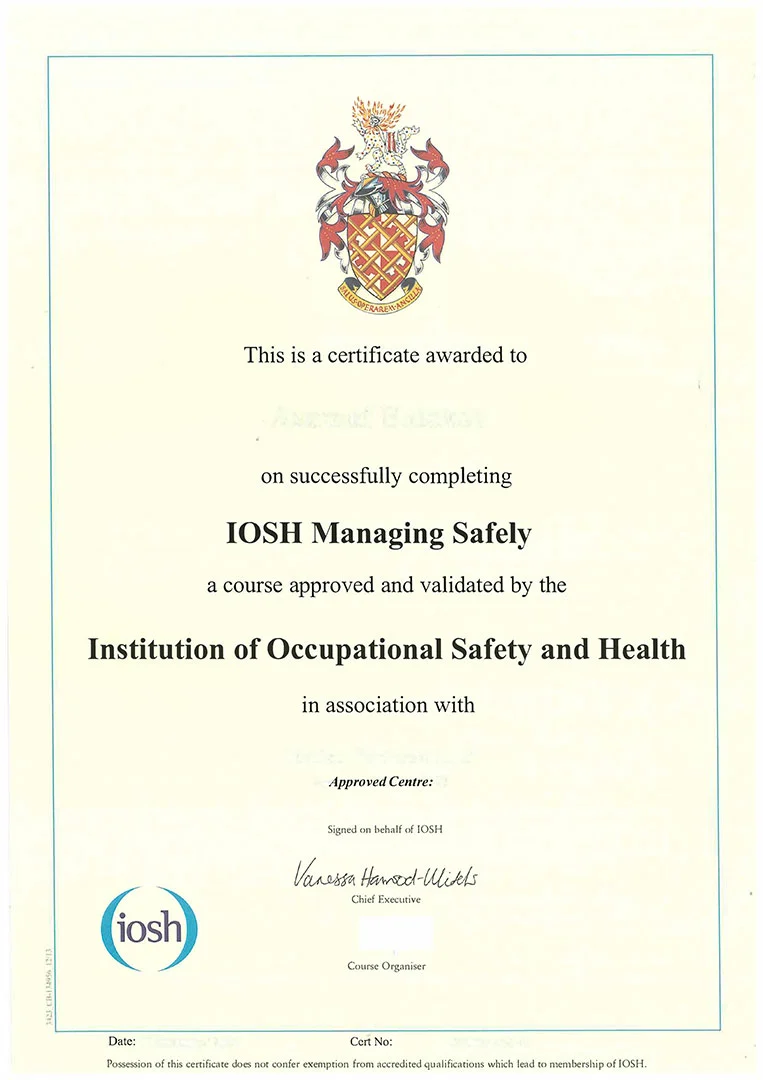
IOSH Certification

СIOSH Certification

IOSH Managing Safely is a world-leading practical course from the UK Institution of Occupational Safety and Health (IOSH). Designed specifically to give non-HSE managers a clear understanding of their safety and risk management responsibilities in the workplace. Translates complex technical and legal HSE norms into clear, business-oriented language.
Target Audience:

  • Senior and middle managers
  • Line managers and supervisors
  • Shop, section, and department heads
  • HR specialists and operational directors

Training Program Curriculum

  • Introduction to managing safety at work
  • Assessing and controlling key risks
  • Understanding management responsibilities
  • Investigating incident and accident causes
  • Measuring safety performance (KPIs)

Key Advantages:

  • Global Reputation: Certificate is recognized by international companies across all sectors.
  • Practical Focus: Course tools can be implemented in the workplace immediately.
  • Business Protection: Reduction in accidents, downtime, and regulatory fines through proactive leadership.

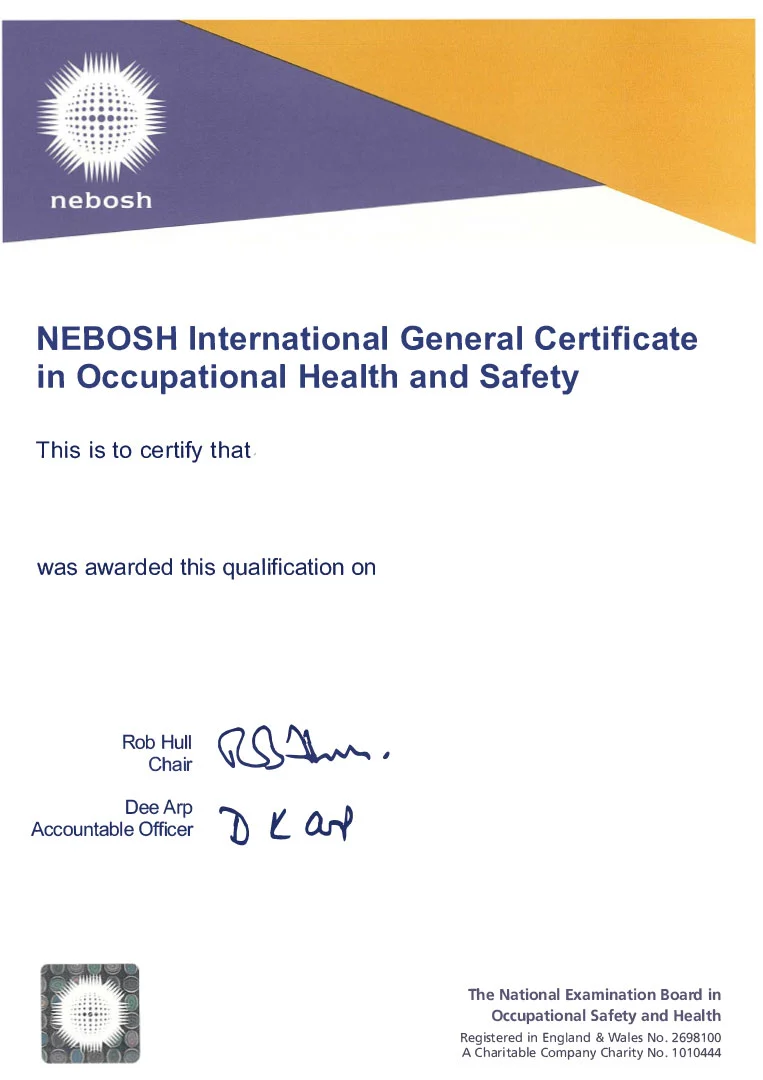
NEBOSH Certification

NEBOSH Certification

NEBOSH IGC is the premier international HSE qualification from the UK National Examination Board in Occupational Safety and Health (NEBOSH). Grounded in ILO standards and global best practices, it provides deep academic and practical knowledge required to design, implement, and audit HSE management systems across enterprises of any scale.
Target Audience:

  • Professional HSE engineers and safety officers
  • Industrial and environmental safety managers
  • Professionals seeking roles in international oil & gas or construction projects
  • CEOs and executive managers of industrial plants

Training Program Curriculum:

  • Fundamentals of international health and safety management
  • Building an effective safety management system (synergized with ISO 45001)
  • Identifying and controlling hazard risks (physical, chemical, ergonomic, biological)
  • Safety psychology and organizational safety culture
  • Conducting workplace safety audits and executive reporting

Key Advantages:

  • Career Breakthrough: NEBOSH IGC is a prerequisite for most global HSE vacancies.
  • Deep Expertise: Learn to communicate effectively with international auditors and clients.
  • Professional Membership: Qualification opens pathways to memberships in professional bodies (e.g., IOSH).

RoSPA Certification

RoSPA Certification

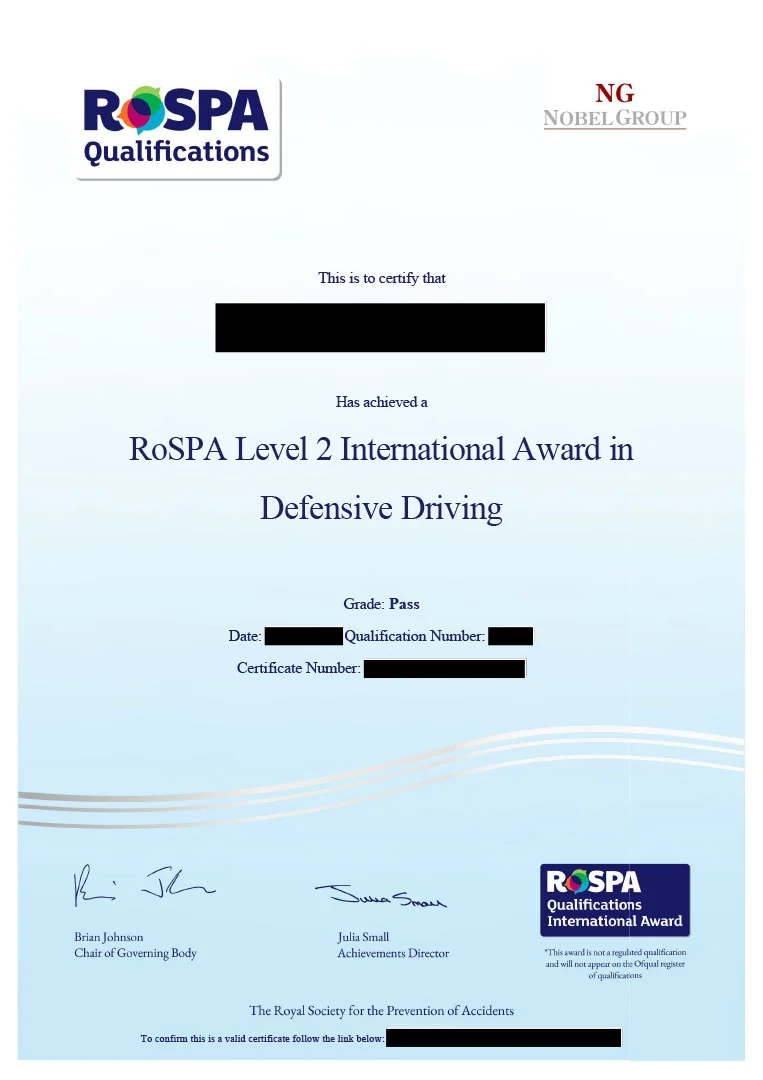
RoSPA Level 2 International Award in Defensive Driving is a specialized international Level 2 course in safe/defensive driving. Developed by the qualifications division of the UK Royal Society for the Prevention of Accidents (RoSPA) with Nobel Group. Aimed at transforming driver mindset: anticipating traffic situations, identifying hidden hazards, and preventing accidents in any weather and road conditions.
Target Audience:

  • Corporate fleet drivers and couriers/freight forwarders
  • Specialized, heavy commercial, and passenger vehicle drivers
  • Transport department managers and logistics heads
  • Any employee operating company vehicles

Training Program Curriculum:

  • Philosophy and core principles of defensive driving
  • Traffic analysis and predicting other drivers' behavior
  • Vehicle handling in extreme conditions (black ice, low visibility, mountain roads)
  • Human factor influence: fatigue, stress, and alertness
  • Eco-Driving principles to reduce fleet wear and fuel costs

Key Advantages:

  • Cost Savings: Tangible reduction in company spending on repairs, fuel, and insurance premiums.
  • Life Saving: Drivers learn how to safely navigate critical road hazards.
  • Brand Reputation: Exemplary driving behavior of corporate fleets enhances company prestige.

Frequently Asked Questions (FAQ)

Which ISO standards are most critical for manufacturing plants?

Three core standards are paramount for factories:

  • ISO 9001 — builds quality management system and cuts defect rates.
  • ISO 14001 — regulates environmental safety and minimizes waste penalties.
  • ISO 45001 — ensures occupational health & safety and cuts workplace injury risks..

How long does turnkey ISO certification take?

On average, procedure takes 2 to 6 months depending on factory size.

  • Timelines depend on the readiness of existing operational processes.
  • TXSA experts accelerate documentation phases using pre-built industry templates.
  • Valid certificate tenure is 3 years subject to annual surveillance audits.

Is it necessary to stop production during the audit?

No, stopping production lines is not required.

  • TXSA auditors work in parallel with normal operational workflows.
  • Audit includes observation, staff interviews, and document review.
  • Verification schedules are customized to minimize disruption for site staff..

What is the main benefit a factory gains from ISO certification with TXSA?

Direct access to large contracts and international markets.

  • ISO is a mandatory requirement for tenders and state procurement.
  • Certificate boosts trust from major clients and investors.
  • Process optimization under ISO standards reduces prime costs through lower overheads.